


The 15-Second Definition
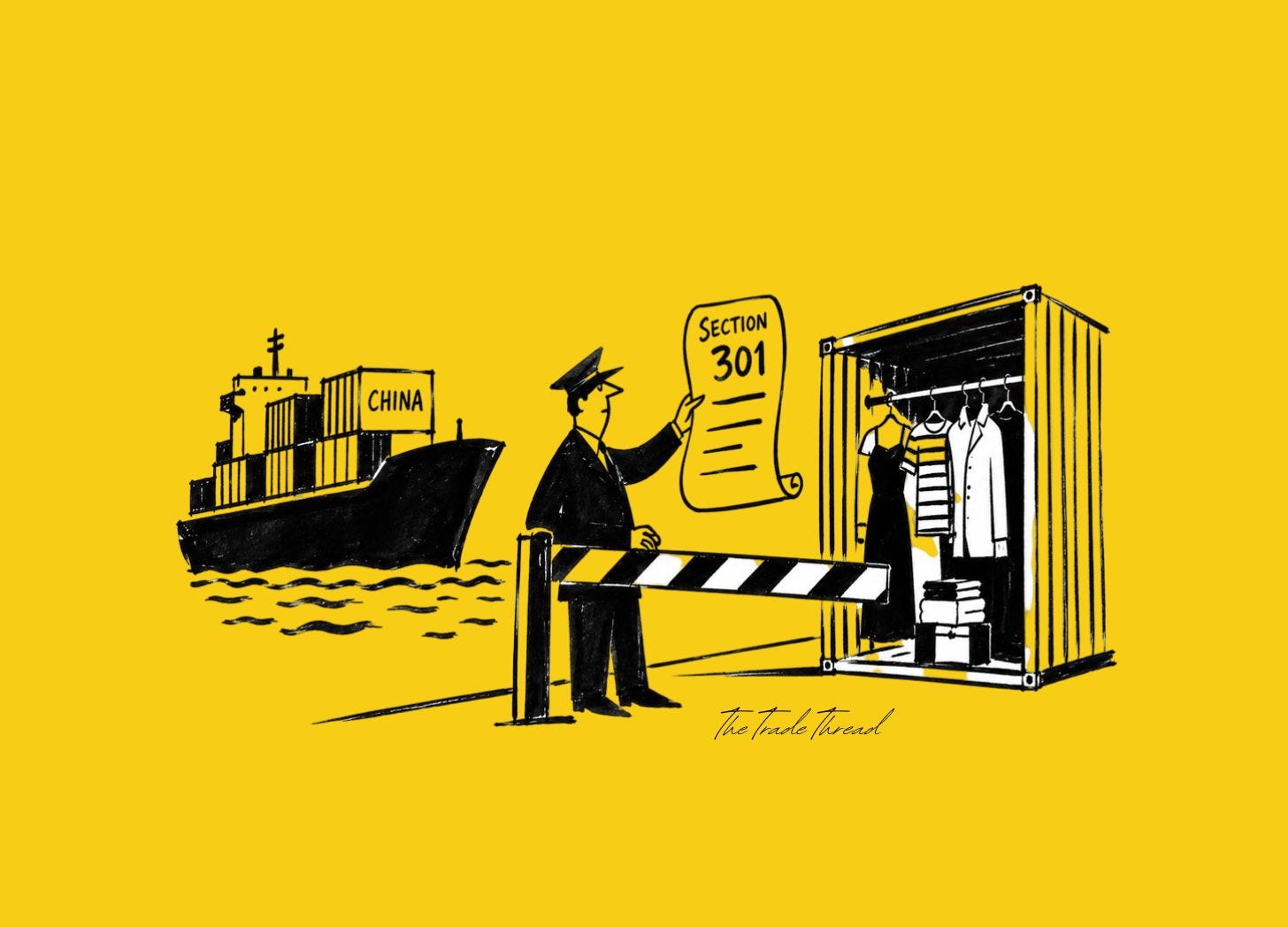
Section 301 is a U.S. law that gives the government authority to impose additional tariffs on imports from specific countries, most notably China.
Unlike Section 232, which focuses on whether imports pose a national security concern, and Section 201, which focuses on serious economic injury to a U.S. industry from increased imports, Section 301 addresses certain unfair or discriminatory trade practices by foreign countries.
It acts as an extra layer on top of standard customs duties rather than a standalone tax. Whether it applies depends on factors including the product’s HTS classification, country of origin, and the specific Section 301 trade action in effect.
Why It Matters
Section 301 can materially change the cost of imported goods. Two products coming from the same country can have different duty treatment because they fall under different HTS classifications.
For apparel and textile businesses, that can affect product costing, margins, pricing, and sourcing decisions. A supplier’s quoted price may look competitive until the applicable duties are factored into the cost of the goods.
Financial Impact
Additional Section 301 duties increase the cost of imported inventory.
The Math: If you import $20,000 worth of goods and a hypothetical 25% Section 301 duty applies, that adds $5,000 in additional duty to the shipment.
That additional cost can be absorbed through lower margins, reflected in retail pricing, negotiated with suppliers, or factored into sourcing decisions.
The key distinction is between the supplier’s price and the landed cost of the goods. The supplier’s invoice is only one part of the total cost of bringing imported inventory into the U.S.
How It Works
Section 301 actions can stem from USTR investigations into certain trade practices of foreign countries. When the U.S. takes action, the resulting additional tariffs apply to specified products rather than automatically covering everything imported from that country.
The products covered by a Section 301 action are identified through specific HTS classifications. Country of origin also matters because Section 301 actions are directed at particular countries.
There can also be exclusions or other provisions that affect the treatment of particular products.
In Practice
Imagine you’re sourcing a new line of cotton knit tops from China.
The supplier’s quoted price tells you what the garments cost, but not necessarily the full tariff cost. The garments have an HTS classification, and their country of origin determines whether a particular Section 301 action is relevant.
If the applicable classification is covered by that action, an additional Section 301 duty may apply on top of the standard duty.
The important point is that Section 301 treatment is tied to the specific goods—not simply to the fact that they came from China.
Section 301 & Apparel / Textiles
Apparel and textile classification can be particularly detailed. The applicable HTS provision can depend on characteristics such as the type of garment, whether it is knitted or woven, its fiber or material content, and other product-specific details.
That means two garments from the same country—and even the same supplier—can fall under different HTS classifications and have different tariff treatment.
For example, a cotton knit top and a woven polyester garment can fall under different HTS provisions.
For apparel importers, “Made in China” isn’t enough information to determine Section 301 treatment. The product’s classification is also an important part of the picture.
Key Takeaway
Section 301 provides the legal authority for certain additional tariffs on imports from specific countries.
For apparel and textile businesses, the important distinction is that Section 301 treatment is product-specific. Country of origin alone doesn’t tell you whether an additional duty applies.
Bottom Line
Section 301 can add a significant cost to imported apparel and textiles, but that cost isn’t determined by country of origin alone.
The applicable trade action and the product’s HTS classification determine whether the additional tariff applies.
© The Trade Thread